

CBAP preparation gets easier when you match the study format to the way you actually learn. The strongest options pair BABOK coverage with scenario practice, timed exams, and clear feedback. Here are the best CBAP certification training options, starting with the most flexible choice.
1. FindExams, Practice-Driven CBAP Preparation
FindExams is an online preparation platform built around question banks, exam simulator s, study tools, and performance analytics. It's best for working professionals who need to study in short sessions without losing sight of exam readiness.
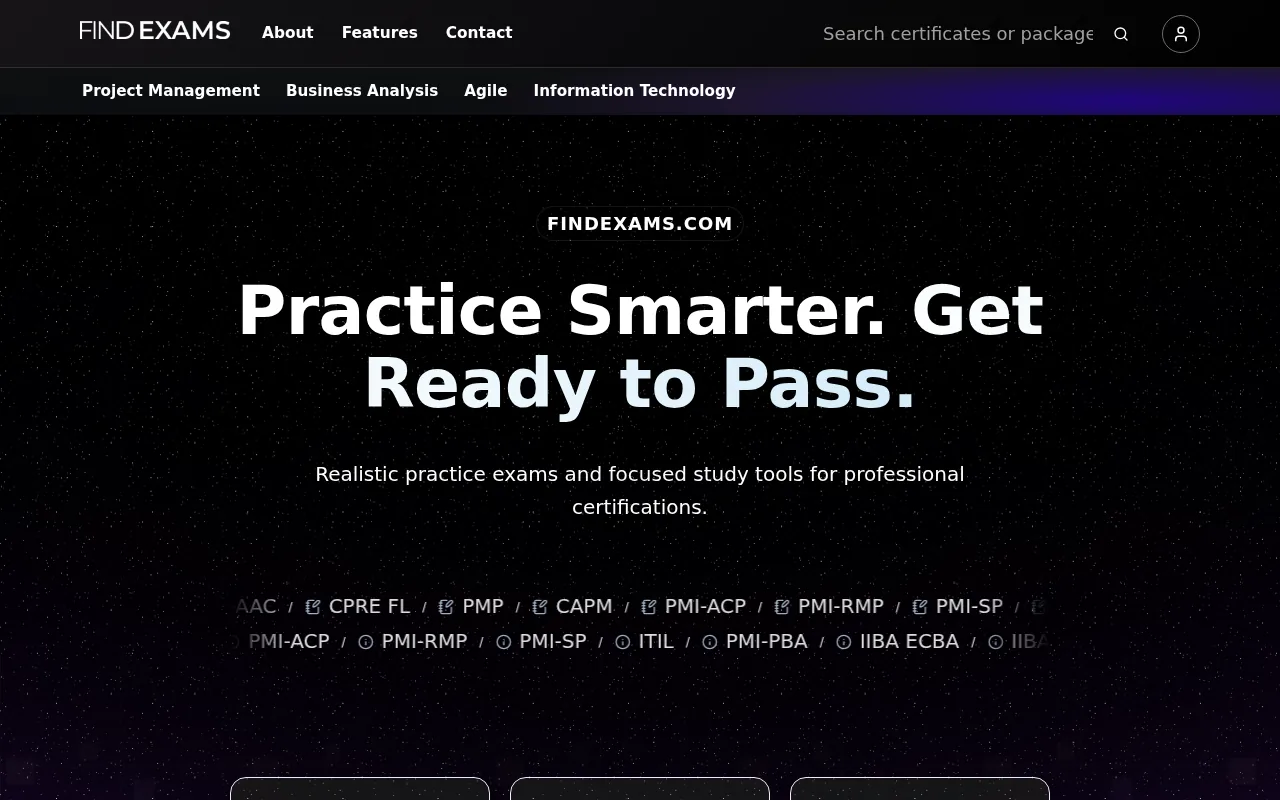
FindExams CBAP Exam Preparation combines online access with realistic exam simulators and alignment with the CBAP exam blueprint. That pairing matters because CBAP questions test judgment in business analysis scenarios. Reading a BABOK chapter alone won't show you how well you can apply a task or technique under time pressure.
You can use a question pool to spot weak areas, then return to those topics before taking another timed session. The platform also fits a longer study plan. Start with untimed practice, review each explanation, then move toward full exam-style sessions.
The main caveat is simple. An online platform won't replace live discussion if you learn best by asking questions in a room. You must also build your own schedule and protect study time.
For a flexible route, FindExams is the clearest starting point. You get the practice loop first, then use your results to decide what to study next.
2. Learners Ink CBAP Certification Training, Classroom Instruction With Simulated Exams
Learners Ink CBAP Certification Training is an in-person classroom option with an IIBA-aligned curriculum. It's best for senior practitioners who focus better with a live instructor and peer group.
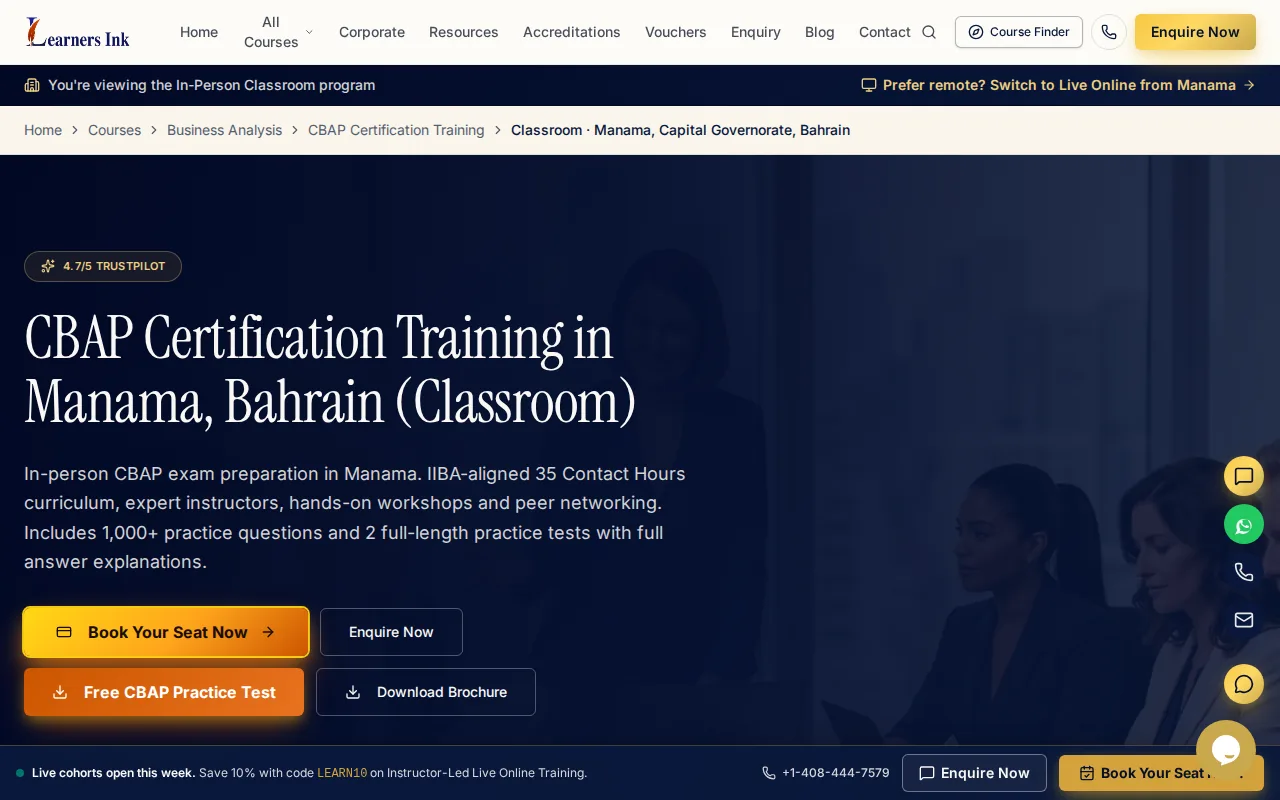
The course includes answer rationales. That level of detail helps you review the reason behind an answer, not just mark it right or wrong. The course also maps its content to the official IIBA CBAP exam blueprint.
Classroom study can help when you need outside pressure. A scheduled session makes it harder to postpone the work, while peer discussion can expose gaps in how you interpret stakeholder, strategy, or requirements scenarios.
The trade-off is travel and fixed attendance. A classroom cohort may also move faster than your weak areas allow. Ask how much access you get after class and how the provider handles missed sessions before paying.
Review the course page when you compare delivery models.
Choose this route when accountability and direct feedback matter more than location freedom.
3. Simply Learn, Live Online Instruction Aligned With IIBA Standards
Simply Learn uses live online sessions led by instructors, with content described as IIBA V3 aligned. It's best for learners who want teaching and structure without commuting.

Live instruction gives you a place to ask why one answer fits a scenario better than another. That matters across the six BABOK knowledge areas, especially when a question blends planning, elicitation, requirements work, or solution evaluation.
Course material from Simply Learn also covers exam eligibility, the application process, the exam outline, and recertification topics. That broader coverage can help you avoid a common mistake: treating training completion as the same thing as certification eligibility.
Still, live online classes require a reliable connection and steady attendance. A session that runs during your workday may be hard to absorb. Check the class schedule, replay policy, and amount of independent practice before you enroll.
If you already understand the basics, use live sessions to test your reasoning. If you need to learn at odd hours, a self-paced course may fit better.
4. Self-Paced IIBA-Aligned CBAP Courses, Flexible Study for Working Professionals
Self-paced CBAP certification training lets you study around work, family, or travel. It's best for disciplined learners who can set weekly targets without a live class.

When comparing online study options, check whether they include practice questions, case studies, scenario items, targeted drills, randomized exams, and progress tracking. Practice can support a useful progression: learn a topic, drill it, then test it under exam conditions.
Pricing can change, so treat any displayed rate as a point-in-time quote.
Self-paced study can become passive video watching. Set a weekly output instead. For example, complete one knowledge-area review, explain missed answers in your own words, and finish a timed block before moving on.
This format works well when flexibility is your main constraint. It works poorly when your calendar keeps winning.
5. Virtual Classroom CBAP Programs, Real-Time Teaching Without Travel
Virtual classroom programs bring an instructor and cohort together through a webinar. They're best for learners who want real-time teaching but can't attend a local venue.

One researched program gives learners a choice between four consecutive days or eight half-day sessions. It includes 35 contact hours and access to an online study exam simulator. That split schedule can help you fit preparation around work while keeping a firm course rhythm.
Ask how the instructor handles scenario questions. A useful class should make you explain your choice, compare distractors, and connect the question to a BABOK task or technique. Passive slide review won't build that skill.
Time zones are another usable issue. A course held in a different time zone can turn evening learning into a late-night burden. Confirm session times, recordings, participation rules, and support after the final class.
Virtual classrooms sit between self-study and a physical course. You get human guidance, but you still need a quiet space and reliable access.
6. In-Person CBAP Training, Structured Accountability and Peer Interaction
In-person CBAP training gives you a fixed room, set hours, and direct contact with other business analysts. It's best for learners who need a strong boundary between work time and study time.

The researched classroom model covers the BABOK Guide version 3 framework and includes sample questions. It also provides 35 professional development hours, which can support the education part of an IIBA application when the provider's documentation meets current requirements.
Peer work is useful when you compare how different analysts read the same scenario. One person may focus on stakeholder needs, while another spots a requirements life cycle issue. That discussion can sharpen your judgment.
There are limits. Travel adds time and cost. A fast four-day workshop may also introduce many concepts before you've had time to absorb them. Ask whether you receive practice access after the course and whether the schedule includes review time.
Pick this format when routine matters. A room full of learners can make study feel like a work commitment rather than another task on your home screen.
7. CBAP Practice Exam and Simulator Platforms, Build Speed, Stamina, and Confidence
Practice exam platforms focus on the test loop itself. They're best for candidates who already know the material but need better pacing, stamina, and answer review.

A simulator should do more than shuffle questions. Look for timed sessions, topic filters, explanations, performance data, and a way to revisit missed items. Full-length practice matters because the CBAP exam is commonly described as a 120-question, 210-minute test format in the training research.
FindExams is a strong fit here because its CBAP preparation centers on realistic exam simulators and readiness tracking. Use the results to guide your next study block instead of chasing a raw score.
| Simulator feature | What it helps you check | Warning sign |
|---|---|---|
| Timed full exam | Pacing and mental stamina | Only short quizzes are available |
| Answer rationale | Why the best option fits | Answers show no reasoning |
| Topic reports | Which knowledge areas need work | One total score with no detail |
| Randomized question pool | Recall across varied scenarios | The same order repeats |
Take at least one long session in the same kind of setting you expect on exam day. Practice breaks only if your exam rules allow them, and don't wait until the final week to test your stamina.
8. CBAP Study Groups and Community Support, Learn Through Peer Accountability
Study groups add a shared schedule and peer support to CBAP certification training. They're best for learners who understand the material better after talking through examples.

A structured study group can provide expert guidance and peer support. That model can keep you moving through the BABOK Guide instead of spending weeks on one familiar topic.
Use the group for explanation, not answer swapping. Each member should say which task or technique shaped their choice. That habit builds the kind of reasoning scenario questions require.
Set a clear meeting rule. One person brings a question, another explains the chosen answer, and the group checks the reasoning against the study material. If a debate has no evidence, mark the topic for later review.
A group won't fix an unreliable plan. Pair it with a question bank and individual timed work. Community support is most useful when it adds accountability to your own study loop.
9. Budget-Friendly CBAP Preparation, Free Resources, Scholarships, and Cost Planning
Budget-friendly CBAP preparation combines official information with focused practice. It's best for candidates who need to control spending without skipping the exam basics.

Start with current certification fee information. Certification costs can include membership, application, exam, retake, and recertification charges, and the exact amount may vary by membership status or region. Check the current figures before building your budget.
Course prices also vary widely. Compare the full package, not just the course name. Ask if the fee includes contact hours, practice exams, study access, and post-course support.
Lower-cost preparation can work when you already have a strong BABOK foundation. Spend first on the gap you can measure. If your issue is pacing, choose timed simulations. If your issue is concepts, choose guided instruction or a study group.
Don't treat a free resource as a full preparation plan. Use it to learn the exam shape, then confirm weak areas with scored practice.
10. PMI-PBA-Focused Training, An Alternative for Broader Business Analysis Credentials
PMI-PBA-focused training is an alternative for professionals whose business analysis work sits inside project and program delivery. It's best for project managers, product professionals, and analysts who work closely with delivery teams.

CBAP centers on the IIBA framework and BABOK knowledge areas. PMI-PBA focuses more directly on business analysis within project work, including stakeholder needs, requirements, project outputs, and business goals. The better choice depends on the work you want your credential to describe.
Choose CBAP when you want a senior business analysis credential tied to the IIBA path. Choose PMI-PBA when your role is closely tied to project management and you want that connection made clear.
You can also hold both credentials, but that only makes sense when each one supports a different career goal. Compare eligibility, exam structure, renewal duties, and employer recognition before paying for a second exam.
For a side-by-side view of the two paths, the PMI-PBA vs CBAP certification comparison can help you frame the decision around role fit rather than title appeal.
FAQ
What is the best CBAP certification training option?
The best option depends on how you study, but FindExams is the strongest starting point for flexible exam practice. It combines online access with realistic simulators and blueprint-focused preparation. Choose classroom or live instruction instead if you need scheduled teaching, direct questions, or peer accountability to stay on track.
How much experience do I need for CBAP certification?
CBAP eligibility generally requires 7,500 hours of business analysis work in the previous 10 years, with at least 900 hours in four of the six BABOK knowledge areas. You also need 35 hours of professional development, two references, and agreement to the professional code of conduct. Confirm current rules before applying.
How long does CBAP certification training take?
CBAP certification training can take several weeks or longer, depending on your experience and study time. Some live programs deliver 35 contact hours across four days or eight half-day sessions. A self-paced plan may take longer because you control the pace. Set a target date, then schedule regular practice and review.
What should a CBAP practice exam include?
A useful CBAP practice exam should include timed sessions, scenario questions, answer explanations, and topic-level performance data. Full-length tests also help you build stamina for the 120-question exam format described in the training research. Review every missed answer and record the BABOK concept behind your mistake.
How do I maintain the CBAP certification?
Maintaining the CBAP certification requires continuing professional development and recertification activity. Training sources commonly describe a three-year cycle with 60 continuing development units, plus a recertification fee. Rules and fees can change, so check the current IIBA requirements before planning your renewal activities.
Conclusion
Choose FindExams if you want flexible CBAP preparation built around realistic practice and readiness tracking. Start with a diagnostic session, note your weakest knowledge areas, and build your study calendar around timed review. When you're ready, explore FindExams CBAP Exam Preparation and begin your first practice set.
